
czechoslovakian wolfdog "od Úhoště"
How puppies are raised? |
 Italiano [IT]
 Español [ESP]
 Francais [FR]
 Deutch [GER]
 Poland [POL]
 English [ENG]
 Česky [CZ]
|
The puppy breeding process actually starts when I start planning the mating at the beginning of the year. Anyone who knows me knows that it is a lengthy process and often interested parties have to wait until May for the publication of the complete breeding plan. I select the breeding dogs very carefully and each litter should be a benefit to the breed. By the way, you can read about what I am looking for in my breeding HERE. Once the mating dogs have been selected and everything has been agreed with the owners of the breeding dogs, the co-owners and I just wait for the bitches to start their heat. Before each mating, all the bitches are dewormed for the last time. And if the previous litter "didn't please me", I also have them tested for sexually transmitted diseases. If the bitch is positive for any infection, I treat such a bitch. So all my bitches are HEALTHY before mating!
Since I go to mating not only with my own bitches, but also with bitches that are co-owned, the whole event is quite logistically demanding. Bitches usually come into heat in groups, those that live together always come into heat together. So I often go to one mating marathon with my own bitches and go with others when they want to be mated. So I always try to find mating dogs for groups of bitches that are not too far apart. It doesn't always work out and I have to change plans at the last minute, but usually everything is organized.
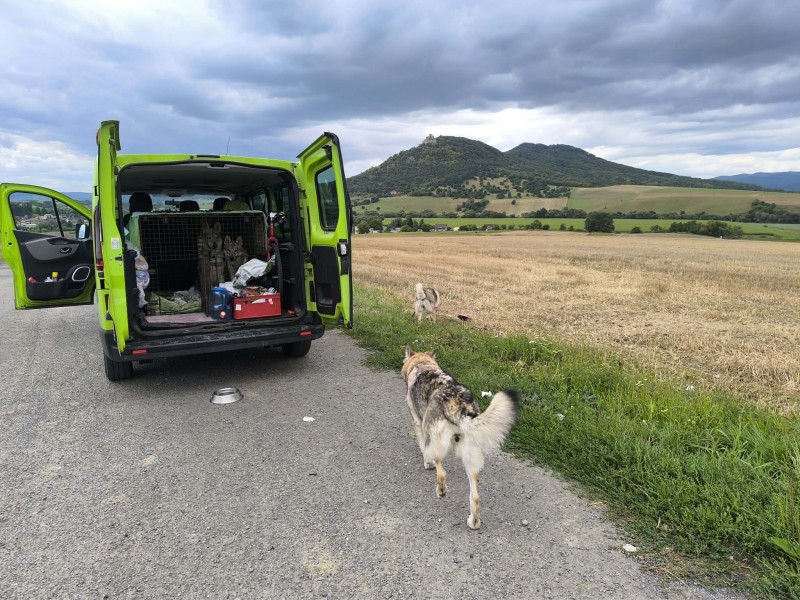
So when the bitches are already in ovulation, I load up the car and we go. Such trips are usually like mini-vacations. I load up a car full of bitches and if there is room, I also take those that are not in heat and we take a trip for several days.

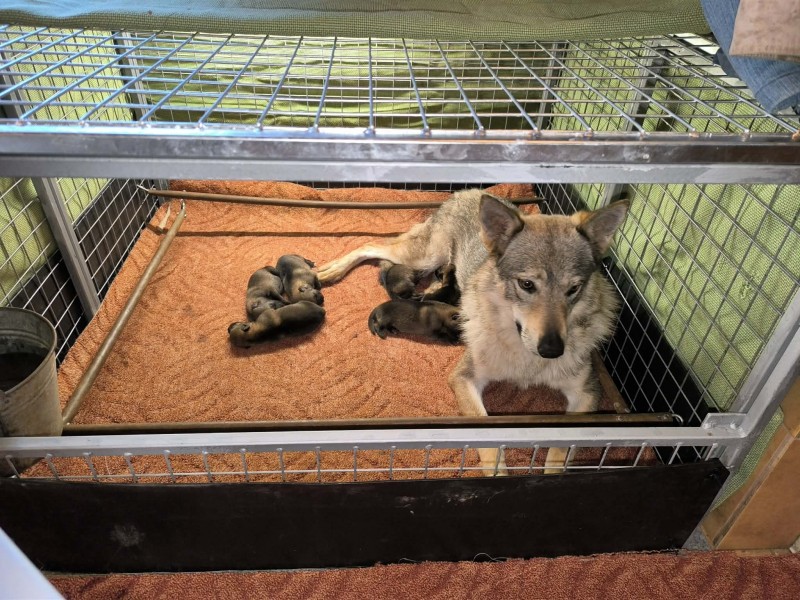
And then we just wait to see how successful the trips were. We go for ultrasounds with some of the bitches, so you can see photos of the unborn puppies. But usually I can tell a bitch is pregnant very early on, so I don't need an ultrasound.
About a week before the birth, our hallway, which is used by people all year round, is transformed into a maternity ward.
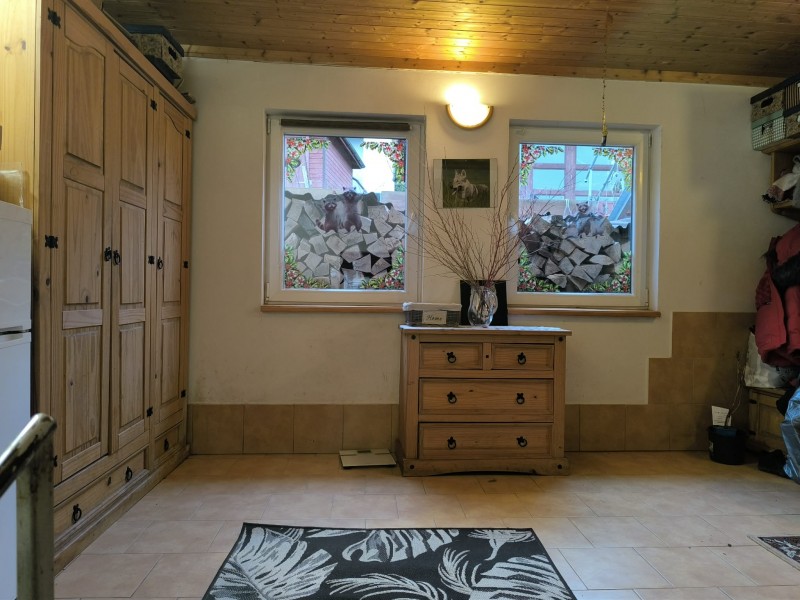
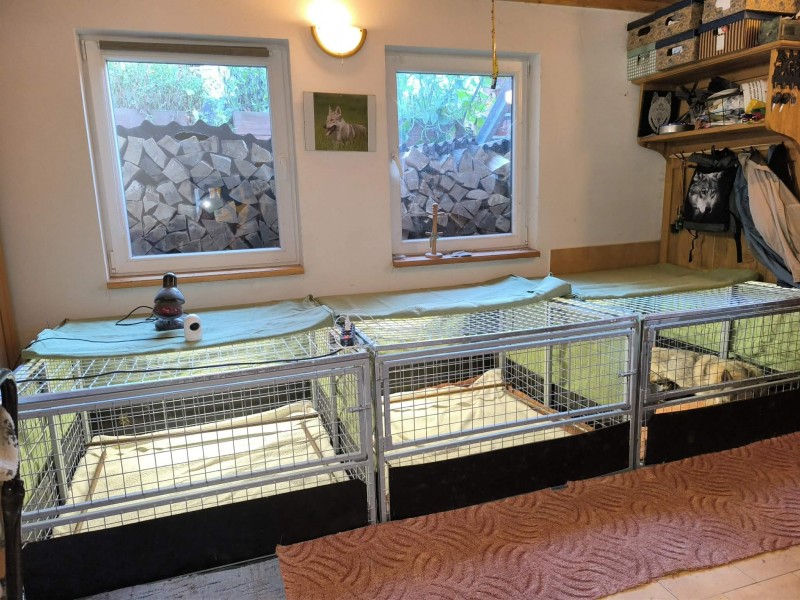
Birthing boxes are brought into the hallway, which are currently foldable cages. In the entire time I've been raising puppies, I've used many types of birthing boxes and maternity wards. Every year I've tried to perfect these boxes so that they're comfortable for the mothers and for me. So I ended up with cages that have a raised threshold so that the puppies don't get out, are foldable so that they take up minimal space after use, and the size has also stabilized to such an extent that I can fit three of them side by side in the hallway. And why cages? There aren't always bitches in the maternity ward who know each other. And so that everyone is safe and has privacy with their puppies, the cages are lockable and secure. The future mothers of the puppies are in the delivery rooms a few days in advance so that they can settle in and each one knows which delivery room is currently hers. Just before the birth, the entire corridor and the delivery rooms are disinfected again, the lights are turned on, the cameras are activated, everything is prepared for the upcoming birth(s).
I have been with the bitches continuously since the birth. I have a bed at the delivery rooms and, if necessary, I bivouac in the delivery room for several weeks, depending on how the births follow each other.
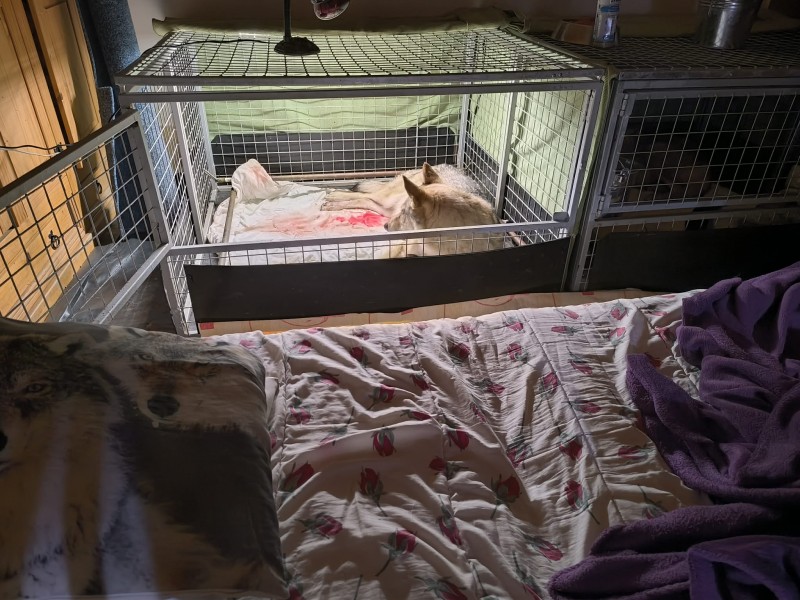
Sometimes it is also necessary to stay away from the puppies, perhaps because some of them need help with their birth and to be cared for practically continuously.
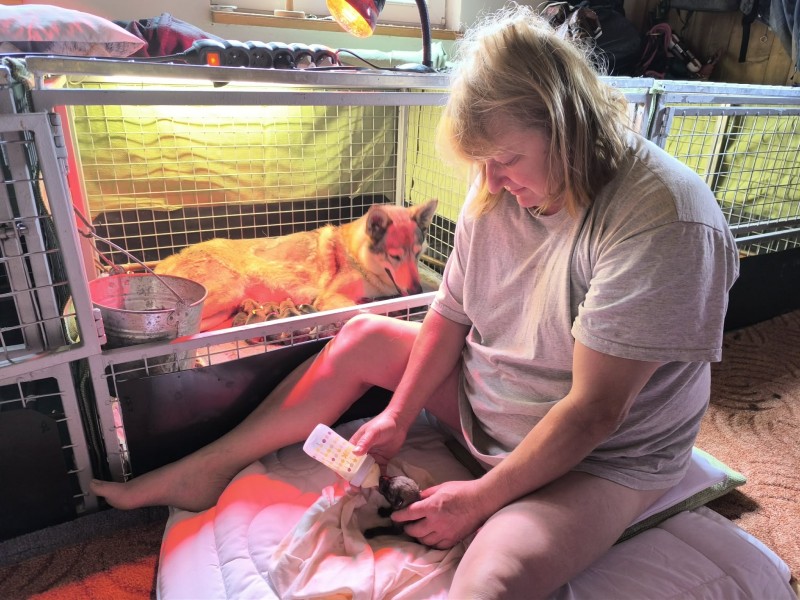
The bitches are in the house with the puppies for about three weeks. It depends on the weather, the number of puppies and their desire to learn to eat from a bowl. When I am sure that all the puppies can eat solid food on their own, the families move outside. We welcome any visitors to the puppies while they are still in the house.
Before moving out, I prepare outdoor pens that are intended only for raising puppies. They are smaller pens, with larger kennels. The pens are concrete, with a roofed area in front of the pens and in the lee. The material used for the pens is a strong mesh with mesh dimensions of 5x5cm. The mesh size is chosen in this way so that no puppy can get into the mesh and cause injury. The concrete floor is so that these pens can be cleaned properly. Before the puppies come in, all these pens, including the kennels, are sprayed with a high-pressure cleaner, then burned with a flame and disinfected. Since I have been raising puppies for decades, I am aware of the existence of a phenomenon called "environmental fatigue". Which is simply the saturation of the environment with pathogens from all previous litters and also from the lives of other adult dogs in the same place. So: our puppies DO NOT move around the garden with other adult dogs during the breeding period, so that they do not come into contact with grass or muddy surfaces, where coccidia, giardia, tapeworm or roundworm eggs or other creatures can be found. Before moving out of the house, the puppies and their mother are dewormed, so they go to the prepared kennel free of parasites. The kennel has a concrete floor, just cleaned and burned, so there is no risk of redness. When the puppies' kennel is small and they start to leave it, they first move around on the concrete roofed area in front of the kennel. This area is also disinfected and burned and other adult dogs do not have access to it. When this area is too small for them, the puppies are released into a larger enclosure during the day, which is also "clean". So the puppies do not move around on an unpaved area. And this enclosure is not visited by other adult dogs, only mothers of puppies.
This is my way of raising puppies and trying to keep them parasite free until they are picked up. Just before each puppy goes to their new home, the puppy is dewormed for the last time, so theoretically they leave me "clean".
|